
Common Condo Door Problems in Kuala Lumpur (and Practical Fixes That Actually Work)
A door that won’t close smoothly, scrapes the floor, or needs a “slam” to latch is more than just annoying—over time it can damage hinges, frames, and locks (and in condos, it can also become a security concern). The good news: most door issues come from a few predictable causes like loose hinges, misaligned strike plates, or a dry/sticky lock.
This guide shares practical, condo-friendly troubleshooting for door repair in Kuala Lumpur, including:
- How to tighten hinges properly
- How to adjust a strike plate
- How to lubricate a lock (and what lubricant to use)
- How to spot alignment issues (sagging, rubbing, latch problems)
- A simple troubleshooting flowchart
- When to stop and call a handyman in Kuala Lumpur for door adjustment or lock replacement
Quick signs your door needs attention
Here are the most common symptoms condo owners report:
- Door won’t latch unless you push/pull hard
- Door rubs the floor, frame, or top corner
- Door bounces back after closing (doesn’t “catch”)
- Handle feels loose or wobbly
- Lock is hard to turn or key sticks
- You hear squeaking or grinding from hinges
- There’s a visible gap on one side, but tight on the other
Most of these are fixable with basic checks—just don’t force the door repeatedly (that often makes misalignment and lock wear worse).
1) Loose Hinges: The #1 Cause of Sagging Doors
Symptoms
- Door rubs at the top latch-side corner
- Latch no longer lines up with the hole in the strike plate
- Door feels “heavy” or drops slightly when you lift the handle
Quick DIY checks (safe and easy)
- Open the door halfway and lift it gently by the handle. If it moves up/down, the hinges are likely loose.
- Look at hinge screws—are any backing out or missing?
- Check if the door closes differently depending on whether you push at the top or bottom.
How to tighten hinges (correct method)
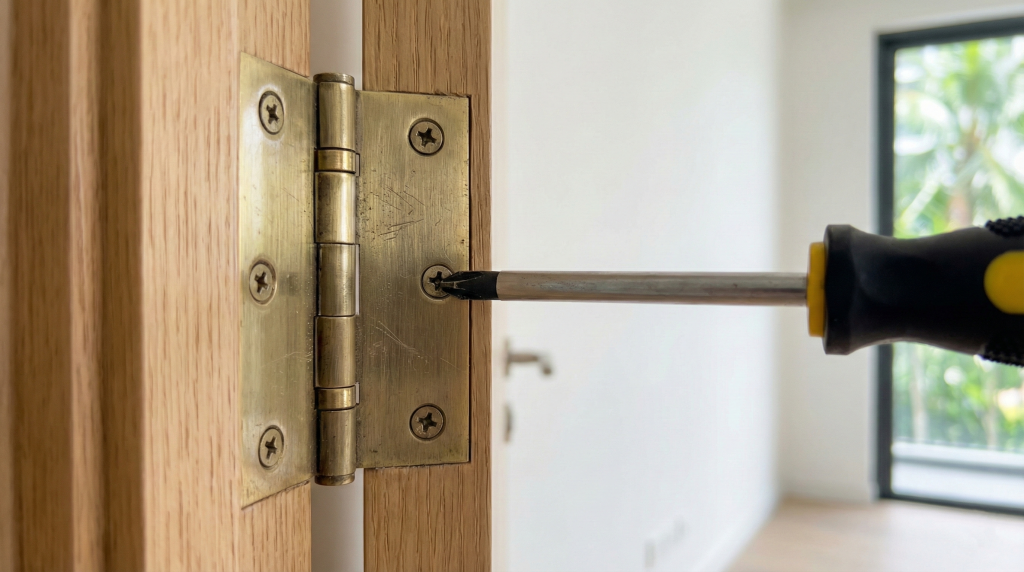
- Use a screwdriver and tighten all hinge screws (top hinge first).
- If a screw keeps spinning and won’t tighten, the hole is worn.
Condo-friendly fix for stripped screw holes (simple):
- Replace 1–2 short hinge screws (usually on the top hinge) with longer screws (e.g., 2–3 inches) only if the frame behind can hold it.
- This helps pull the door back into alignment.
When to stop and call a handyman
- Your condo has a heavy main door (especially fire-rated) and alignment is significantly off
- Screws won’t tighten or the hinge area looks damaged
- The door frame is metal and needs special fixings/tools
What a handyman typically does
- Reinforces hinge points (proper anchoring)
- Re-aligns the door so it latches smoothly
- Checks hinge wear and replaces hinges if needed
2) Strike Plate Misalignment: Door Closes But Won’t Lock
The strike plate is the metal plate on the frame where the latch goes in. When alignment is off by even a few millimeters, your door won’t latch properly.
Symptoms
- Door closes but doesn’t “click” into place
- You must lift/push the door to lock it
- Latch hits the strike plate and leaves scratch marks
Quick DIY checks
- Close the door slowly and watch where the latch hits.
- Look for fresh metal scratches on the strike plate—this shows where it’s rubbing.
How to adjust the strike plate (simple steps)
- Slightly loosen the strike plate screws (don’t remove fully).
- Shift the strike plate up/down/left/right a tiny amount.
- Tighten screws and test.
If the latch is hitting the plate edge, sometimes the opening needs a tiny bit more clearance:
- You can use a small metal file carefully for minor adjustment.
When to stop and call a handyman
- The frame is metal and shifting doesn’t help
- The latch is far off (suggesting hinge/door sag issue)
- You’re dealing with the main entrance lock and want it done cleanly without weakening security
What a handyman typically does
- Aligns latch-to-strike properly (without “over-filing”)
- Repositions strike plate securely
- Checks latch depth and lock function so it locks smoothly
3) Squeaky Hinges: Lubricate the Right Way
Symptoms
- Squeaking or creaking when opening/closing
- Door feels slightly “rough” in motion
What lubricant to use (best options)
- Silicone spray (great all-purpose, doesn’t attract much dust)
- PTFE (Teflon) dry lubricant (very clean, good for condos)
- For hinges specifically, a tiny amount of light machine oil can work, but use sparingly.
What to avoid
- Thick grease (collects dust and gets messy)
- Over-spraying oil that drips onto floors/walls
Quick method
- Open the door.
- Spray a small amount at the hinge pivot points.
- Swing the door back and forth 10–15 times.
- Wipe any excess.
4) Sticky Lock / Key Hard to Turn: Use a Dry Lubricant
Symptoms
- Key doesn’t go in smoothly
- Lock turns only with force
- Lock works sometimes, jams other times
What lubricant to use for locks (important)
For lock cylinders, the safest choices are:
- Graphite powder (classic, dry, doesn’t gum up)
- PTFE dry lube (also clean and effective)
Avoid using WD-40 as a long-term lock lubricant.
It can feel like it “fixes it” at first, but it may attract dust over time and the lock can become sticky again.
Simple DIY steps
- If using graphite powder: puff a small amount into the keyway.
- Insert the key and gently turn it several times.
- Wipe the key clean.
When to stop and call a handyman
- The key is bending or you feel it might snap
- Lock is stiff even after dry lubrication
- The lock is your main door lock and security matters
What a handyman typically does
- Diagnoses whether the problem is the cylinder, latch, alignment, or handle
- Realigns the door/strike so the lock turns easily
- Replaces worn lock components or the full lockset if needed
5) Door Rubbing the Floor or Frame: Alignment Issues
Symptoms
- Scraping sound at bottom edge
- Door sticks at top corner
- Visible uneven gaps around the door
Quick DIY checks
- Look at the gap along the door edges—uneven gap often means sagging.
- Check for loose hinges first (most common cause).
When to stop and call a handyman
- The door is swollen (humidity/water damage) and needs proper planing/adjustment
- It’s a heavy main door or fire-rated door
- The frame looks out of square (structural or installation issue)
What a handyman typically does
- Re-aligns hinges and strike plate together (the correct combination)
- Adjusts latch position and checks door closing pressure
- For severe rubbing: recommends the safest correction without damaging the door
Simple Troubleshooting Flowchart (Text Version)
START
  |
  v
What’s the main symptom?
  |
  +--> A) Door squeaks?
  |        |
  |        +--> Lubricate hinges (silicone/PTFE) -> Test -> DONE
  |
  +--> B) Door won’t latch unless pushed/pulled?
  |        |
  |        +--> Check hinge screws tight?
  |              |
  |              +--> Loose -> Tighten hinges -> Test
  |              |
  |              +--> Tight -> Check strike plate scratches
  |                          |
  |                          +--> Adjust strike plate -> Test -> DONE
  |
  +--> C) Door rubs floor/frame?
  |        |
  |        +--> Check sag (lift door test)
  |              |
  |              +--> Sagging -> Tighten/repair hinge screws -> Test
  |              |
  |              +--> Not sagging -> Call handyman (alignment/frame issue)
  |
  +--> D) Lock/key hard to turn?
           |
           +--> Try graphite/PTFE dry lube -> Test
                   |
                   +--> Still hard OR key bending -> Stop -> Call for lock/door alignment
Checklist before booking a handyman (faster quote, faster fix)
Send these details to speed things up:
- Photo of the door front
- Photo of hinges (top/middle/bottom)
- Photo of the strike plate
- Short video showing the issue (door closing/locking)
- Your KL area, condo level, and parking info
- Whether it’s the main door or room door
- Urgency: today / this week / flexible
Need door adjustment or lock replacement in Kuala Lumpur?
If your door still won’t latch smoothly, the lock is stiff, or you want a secure upgrade, we can help.
WhatsApp us a photo/video of the door + lock + strike plate, and your condo location (area, level, parking info).
We’ll recommend the right fix—door alignment, strike plate adjustment, or lock replacement—and share a quick estimate.